

In English, when we want to refer to something without saying exactly what it is, we have two simple words:
- “this” for things that are close to us
- “that” for things further away.
Japanese, on the other hand, has six words to cover the same ground. That might sound intimidating at first, but the system behind these words is simple and logical.
In this article, we’re going to break down all six words, see exactly when to use each one, and look at how they work in real sentences.
“This”, “That” and “That Over There” – Three Distances, Three Words
In English, we split the world into two zones: things that are here (“this”) and things that are over there (“that”). Japanese takes that same idea but splits it into three zones instead of two. The three words are:
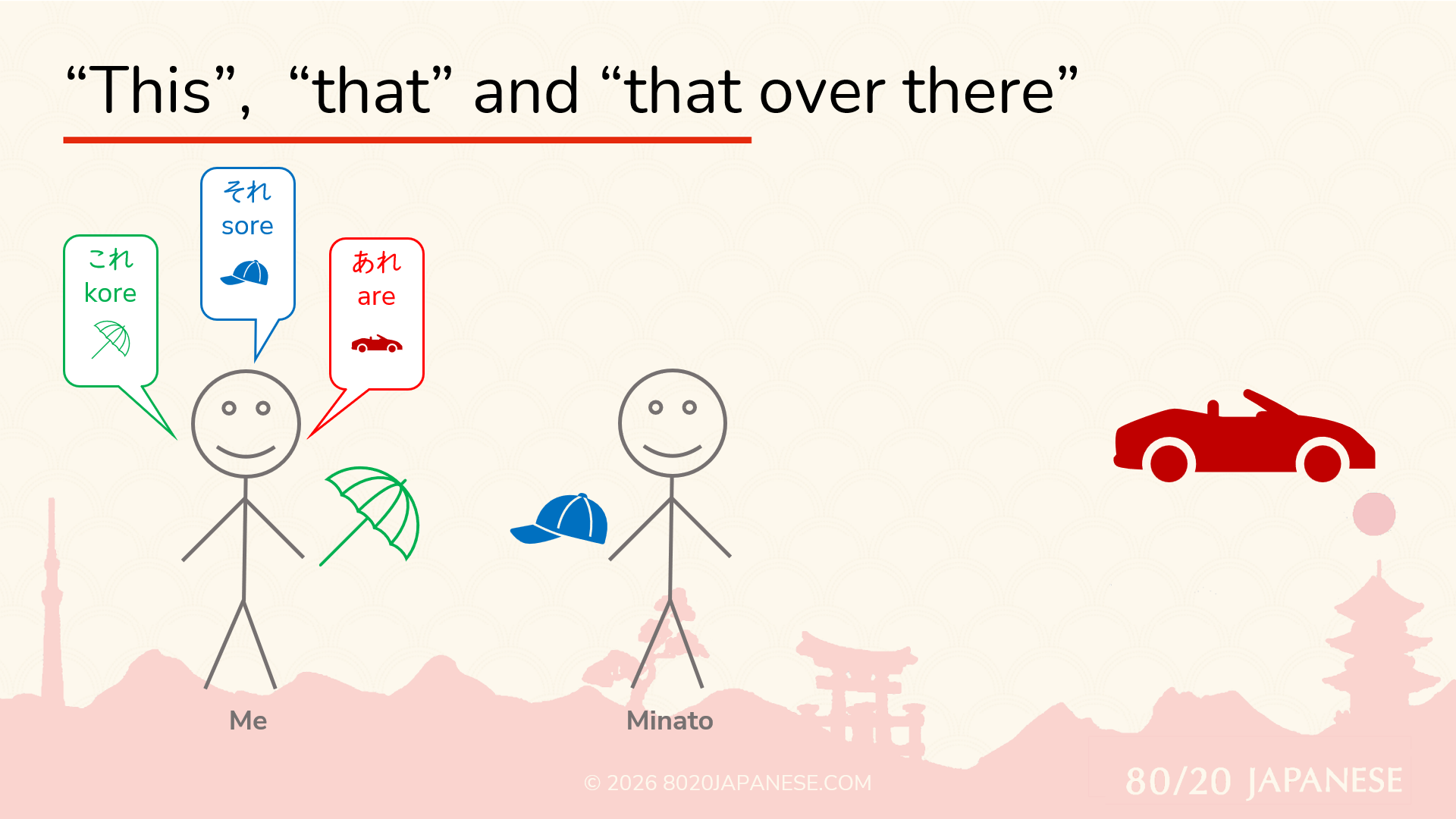
これ (kore) means “this” – it refers to something close to the speaker, just like “this” in English.
それ (sore) means “that”, but is only used to refer to something that is close to the person you’re talking to or that is in their possession.
あれ (are) also means “that”, but is used to refer to something that is far away from both the speaker and the listener. Essentially, it means “that over there.”
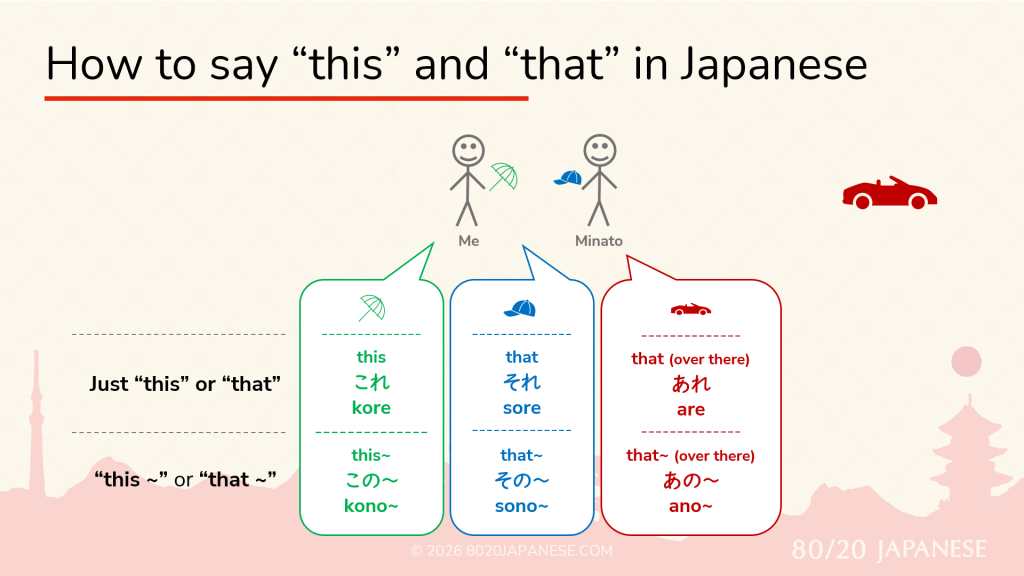
The following diagram demonstrates this:
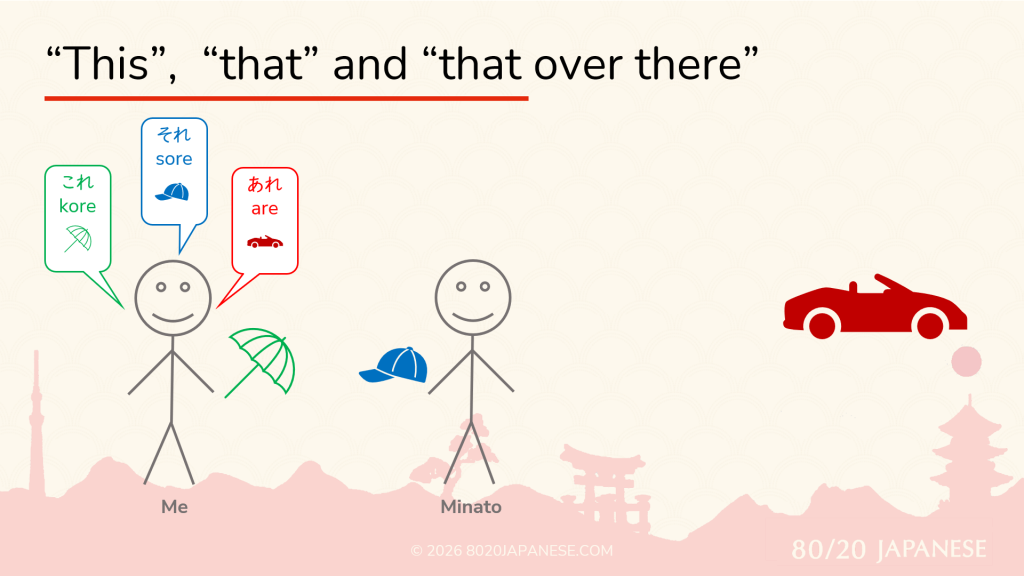
Here, when I want to refer to the umbrella, I would say “kore”, just as I would say “this” in English.
When talking to Minato, I could refer to the hat he has by saying “sore”, since it is close to him or in his possession.
To refer to the car, however, I would say “are”, because the car is far away from both me and Minato.
Essentially, the English word “that” has simply been split into two:
- one word for things near the listener – sore
- another for things far from everyone – are
Using “kore”, “sore” and “are” in simple sentences
Let’s look at how we can use these in some basic sentences.
kore:
sore:
are:
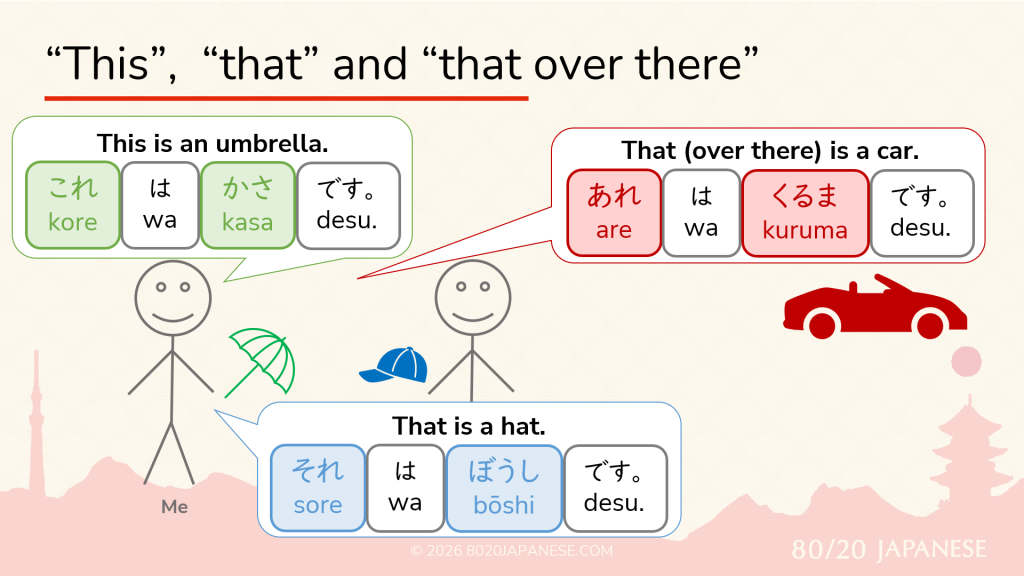
These all follow the simple “A wa B desu” sentence pattern we use to say that two things are equal – that “A is B”. For a more detailed breakdown of how these sentences work, check out my article about basic Japanese sentences.
The other person’s perspective
Something that should be obvious is that both “kore” and “sore” are relative to who is speaking, just like “this” and “that” in English.
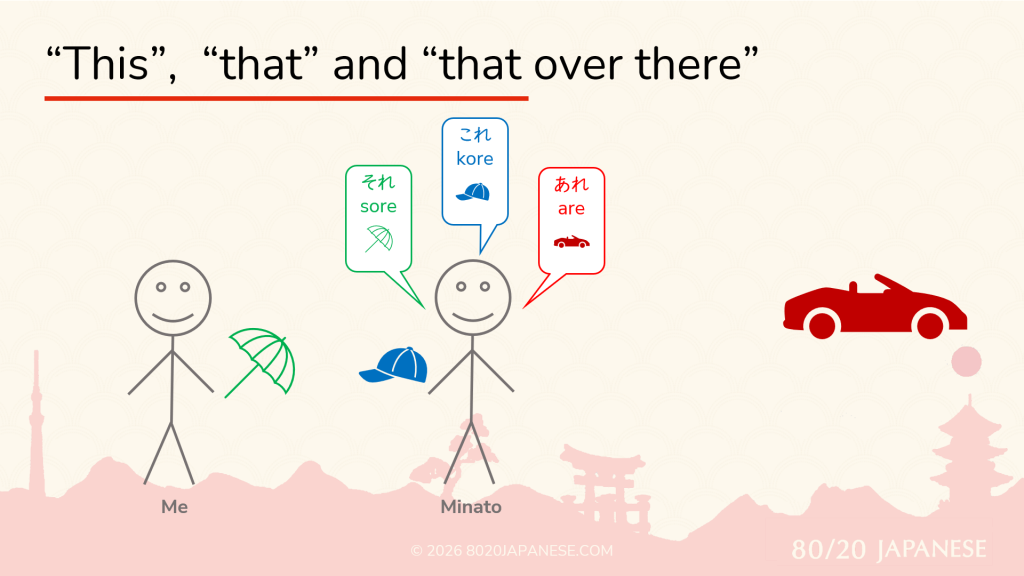
If Minato were the one talking, he would say “kore” to refer to the hat and “sore” to refer to the umbrella. This is exactly like English and should be intuitive.
To refer to the car, however, Minato would also use the word “are”. The car is far from both of us, so regardless of who is speaking, we would refer to the car as “are”.
Saying “This [something]” or “That [something]”
It might be tempting to try to put one of these words immediately before a noun to say “this [something]” or “that [something]”, just like we do in English.
In Japanese, however, there is a separate set of words to use in this situation. Fortunately, they are very similar and follow the same spatial logic.
These words always come directly before a noun. They can never stand alone the way “kore”, “sore” and “are” can.
For example:
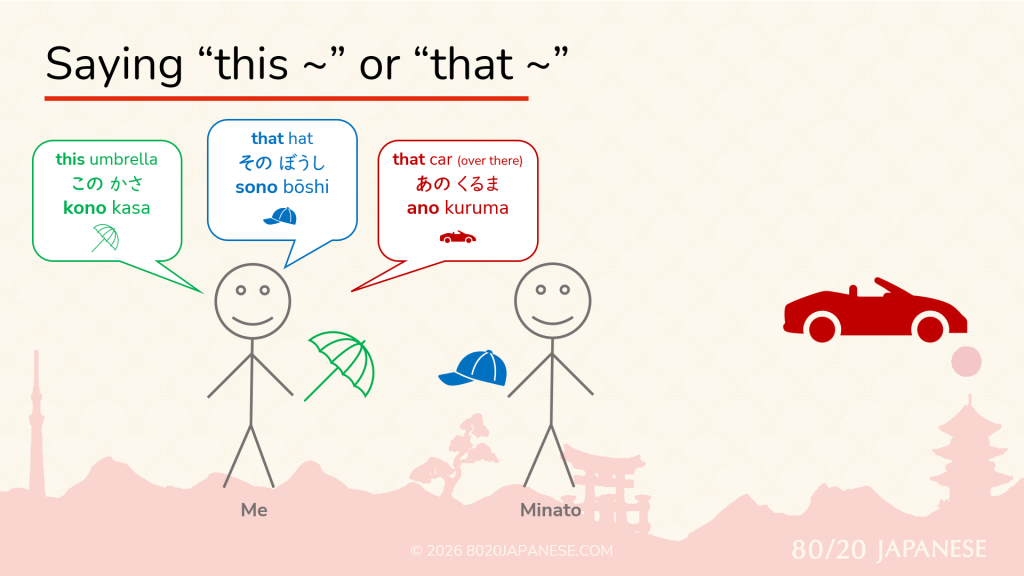
The pattern should be obvious here. The first syllable stays the same (ko, so, a), and follows the same spatial logic as before.
The second syllable then changes according to whether we’re just saying “this” or “that” by itself (re), or if we want to be more specific and say “this ~” or “that ~” (no)
Using “kono”, “sono” and “ano” in sentences
The way we use these in sentences is the same as for “kore”, “sore” and “are” – or any other noun for that matter. Let’s see some examples:
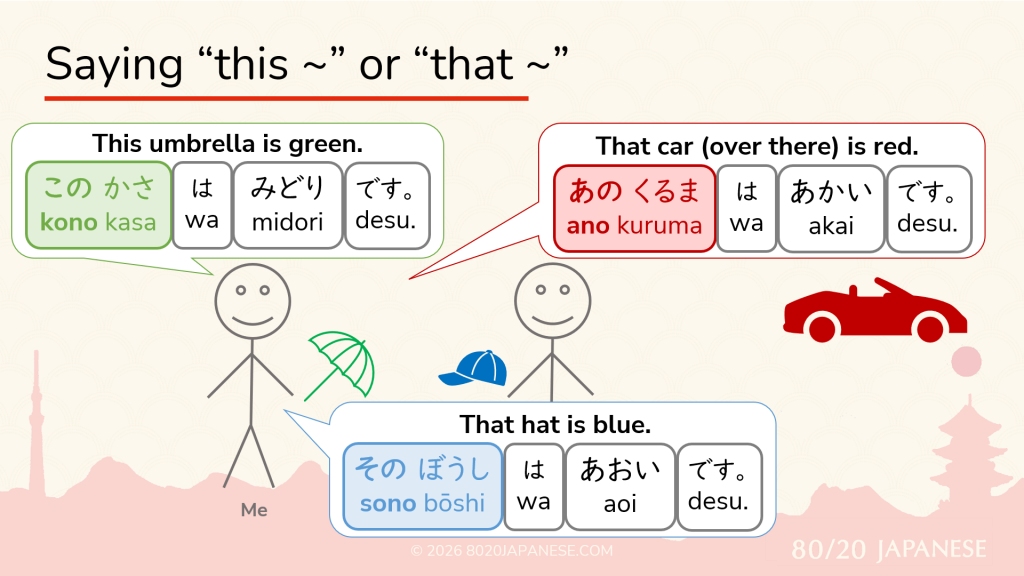
Again, these sentences follow the simple “A wa B desu” pattern. We can use each combination of [kore/sore/are] + [noun] in the same way that we used their simpler counterparts.
Whether we use the standalone forms (kore, sore, are) or the noun-modifying forms (kono, sono, ano + noun), they behave just like any other noun in a sentence.
We can use them as the topic marked by “ha”, as in all of our examples here, or in any other role marked by another particle.
Key Takeaways
Japanese has six words for “this” and “that,” organized into two sets of three. There are two factors that determine which we should use:
- Where the thing is in relation to ourselves and the person we’re speaking to
- Whether we just want to say “this” or “that”, or be more specific and say “this [something]” or “that [something]”.
The words are as follows and are generally not interchangeable:
| Position | Just “this” / “that” | “this ~” or “that ~” |
|---|---|---|
| Near ourselves | kore | kono~ |
| Near the person we’re talking to | sore | sono~ |
| Away from both of us | are | ano~ |
The full video lesson (part of the 80/20 Japanese: Foundations course) also covers how these words are used in more complex sentences with different particles and verbs, as well as an important rule about referring to people. If you’d like to go deeper, check out the full course for step-by-step lessons that build on each other to give you a solid foundation in Japanese grammar.