
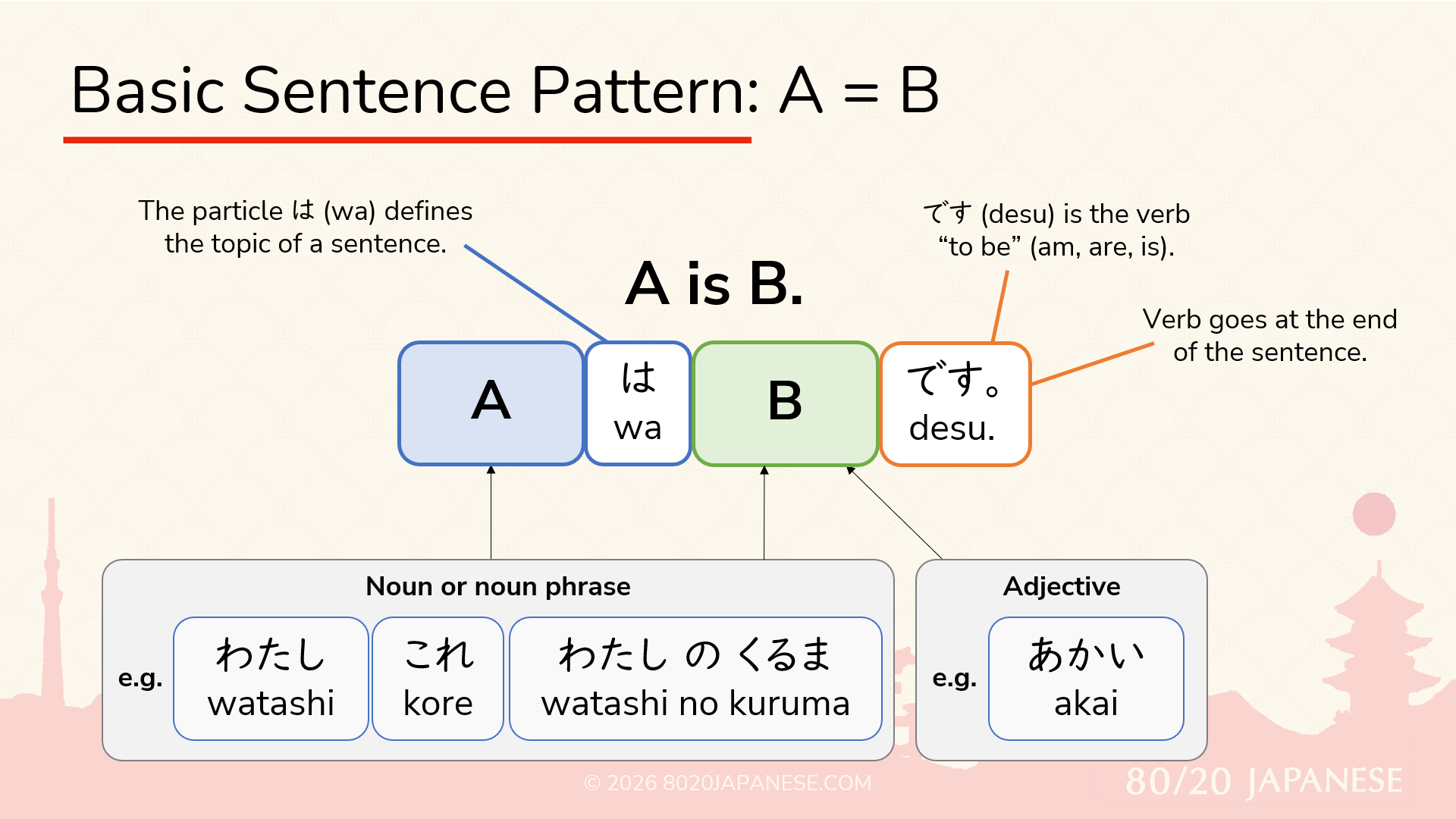

If you’re just starting to learn Japanese, understanding basic sentence structure is your first critical step. Fortunately, Japanese sentences follow incredibly logical patterns once you know what to look at.
In this lesson, we’ll break down the most fundamental sentence pattern in Japanese:
A wa B desu.A は B です。
This how we say “A = B”.
The Basic Pattern: A wa B desu.
In Japanese, we can say that two things are equal, that A = B, using the following pattern:
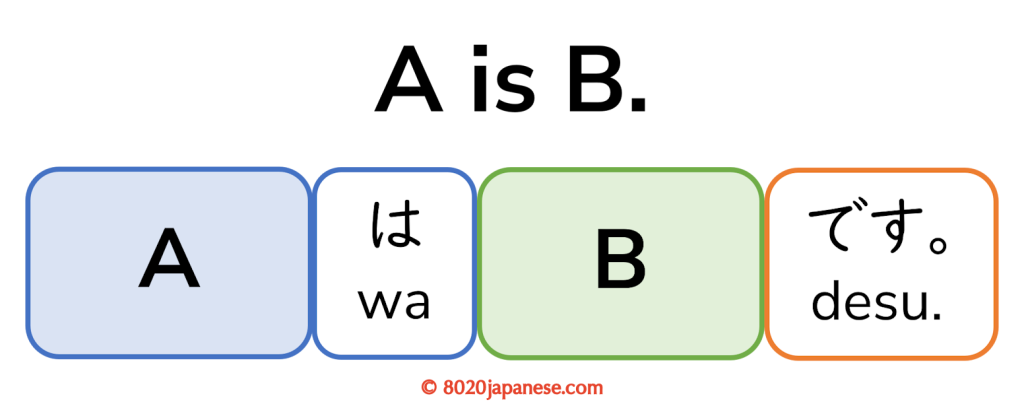
Generally, A should take the form of a noun – a word that describes a ‘thing’. It can be just a simple noun, or it can be a longer noun phrase, which we will look at shortly.
In the place of B, we can also use a noun or noun phrase, or we can instead use an adjective – a descriptive word.
Let’s look at how this works with some simple examples:




As you can see, all of these sentences follow the simple pattern, “A wa B desu.”.
Let’s break these down now and look at the individual components so we can see exactly how these sentences work.
The special verb “desu”「です」
The word at the end of all of these sentences, “desu”, is the verb meaning “to be”, equivalent to “am,” “are,” or “is” in English.
It’s unique among Japanese verbs, and is arguably in a class of its own. For a more detailed explanation of what exactly “desu” is and how it works, check out my article all about “desu” here.
Importantly, though, in Japanese, the main verb goes at the end of the sentence.
We can see this in all of our example sentences above, but this is true for all Japanese verbs, not just “desu”.
Another key point about verbs in Japanese is that the form doesn’t change based on who is doing the action.
In English, we say “I am,” “you are,” “he is” – the verb form changes according to who it is that is “being”.
However, in Japanese, in sentences like these, we would always use “desu” regardless of whether it’s “I”, “you”, “this”, or anything else.
Of course, the verb does change form for other reasons, such as in different tenses or for different levels of politeness, but a key difference with English is that it is not affected by who or what is doing the action.
The Particle “wa”
The particle “wa”「は」 marks the topic of the sentence. It tells us what we’re talking about.
Like most particles in Japanese, it tells us the role of the word or phrase that come before it.
So, in our first example…

…the particle “wa” tells us that this sentence is about “watashi”, meaning “I” or “me”.
For a detailed exploration of how “wa” works as a topic marker, check out my article about the differences between “wa” and the subject-marking particle “ga”.
No articles “a” or “the” in Japanese
One small but significant difference between Japanese and English is that in Japanese, there is no equivalent of the articles “a” and “the”.
Notice that the equivalent of “a car” in this sentence is just the word “kuruma”, meaning “car”:
Japanese simply doesn’t use articles, so this sentence literally translates as, “this is car.” Context determines whether we mean “a car,” “the car,” or even cars in general.
This makes things simpler in some ways, but the lack of clarity can be quite confusing coming from a language like English that relies heavily on articles. For better or worse, it’s just something you need to get used to.
Building Longer Sentences
In our first two example sentences, we just had single words in the place of A and B. However, in our third and fourth sentences, we used slightly longer noun phrases:


In these sentences, we’ve replaced simple words with longer phrases.
In the first example, instead of just a single word for A, we have “watashi no kuruma” – “my car”.
In the second example, we’ve expanded B to “tarō no kuruma” – “Taro’s car”.
Even so, the structure remains exactly the same. All we have done is made the building blocks bigger.
Expanding on the individual parts within a sentence allows us to add more detail to our Japanese sentences, and there are many more ways that we can do this. Still, the overall structure doesn’t change.
Key Takeaways
Here’s what to remember about basic Japanese sentences:
The Pattern: To say “A is B”, we can use the pattern: A wa B desu.
The Verb: “Desu” means “to be” and always goes at the end of the sentence. Its form doesn’t change based on who is doing the action.
The Topic-marking particle: The particle “wa” (pronounced “wa”) tells us who or what the sentence is about.
No Articles: Japanese doesn’t use “a,” “an,” or “the”.
Expandable Parts: Both A and B can be single words or longer phrases. Either way, the overall sentence pattern stays the same.
Understanding this fundamental pattern gives you a solid foundation for everything else you’ll learn in Japanese grammar. As you progress, you’ll see how more complex sentences still follow these same logical principles.
Want to learn Japanese grammar systematically? This lesson is part of my complete course, 80/20 Japanese: Foundations, which focuses on helping you develop a strong understanding of the funamentals of Japanese grammar so you can see how everything fits together and makes sense.
Always great teaching. ありがとう先生。