

Particles are the most essential building block of the Japanese language. They are like little pieces of glue that hold all the information in a sentence together.
If you want to be able to speak or understand Japanese, you must understand what particles are, how to use them, and what each one is for.
Fortunately, the particle system is incredibly logical. Put simply:
Particles tell us how all the words in a sentence relate to each other.
The first step to mastering particles is understanding how they actually work to give a sentence meaning. From there, it’s just a matter of learning exactly what each particle does and when to use them.
In this comprehensive guide, we’ll cover everything you need to know so you can start building real sentences in Japanese from scratch.
First, we’ll look at how particles define the relationships between words, and how we put that all together to build a sentence. Then, we’ll look at the most common particles, one by one, with clear examples of each showing when and how to use them.
Let’s get to it!
What Are Japanese Particles?
Particles are small “words”, usually just one or two hiragana characters, with one very important purpose:
Particles tell us the role of each word (or phrase) in a sentence.
A sentence is made up of several words, but those words don’t exist in isolation – they interact with each other to produce a greater meaning. Each word in a sentence plays a certain role, such as the person doing the action, the thing the action is being done to, the location where the action takes place, and so on. In Japanese:
Each particle tells us the role of the word or phrase that comes before it.
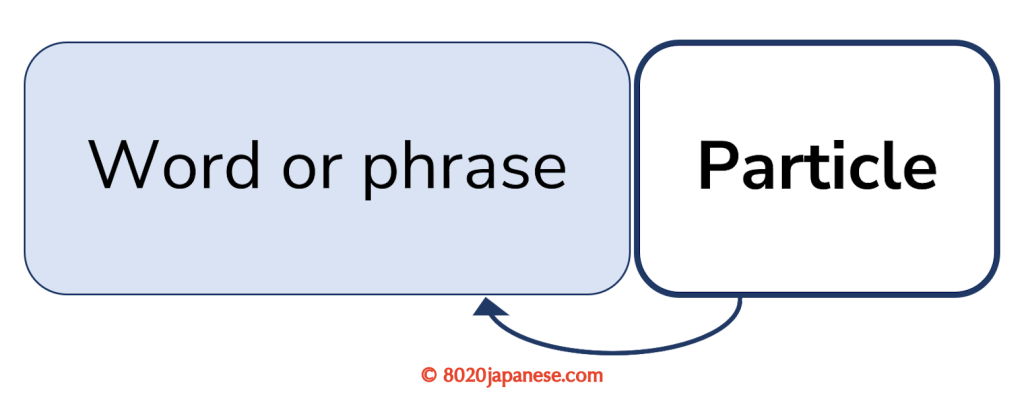
Particles effectively “mark” each element in a sentence, and tell us how they relate to the other parts of the sentence.
Take this example:
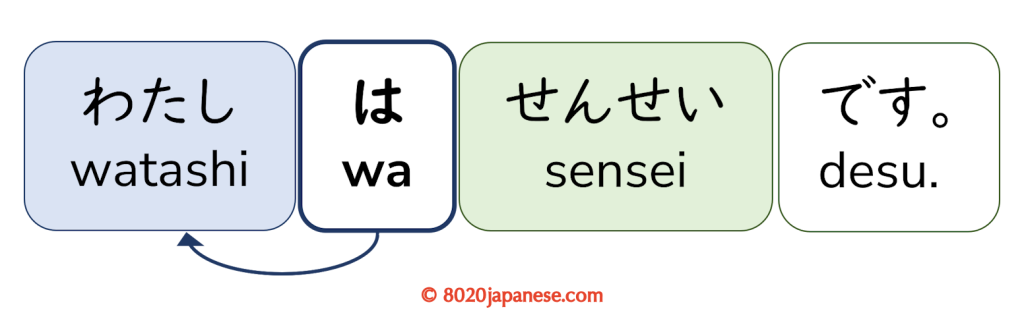
Here, the word “watashi”, meaning “I”, is marked by the particle “wa”. This tells us that “watashi” is the topic of this sentence – the thing we’re talking about.
Here’s another example:
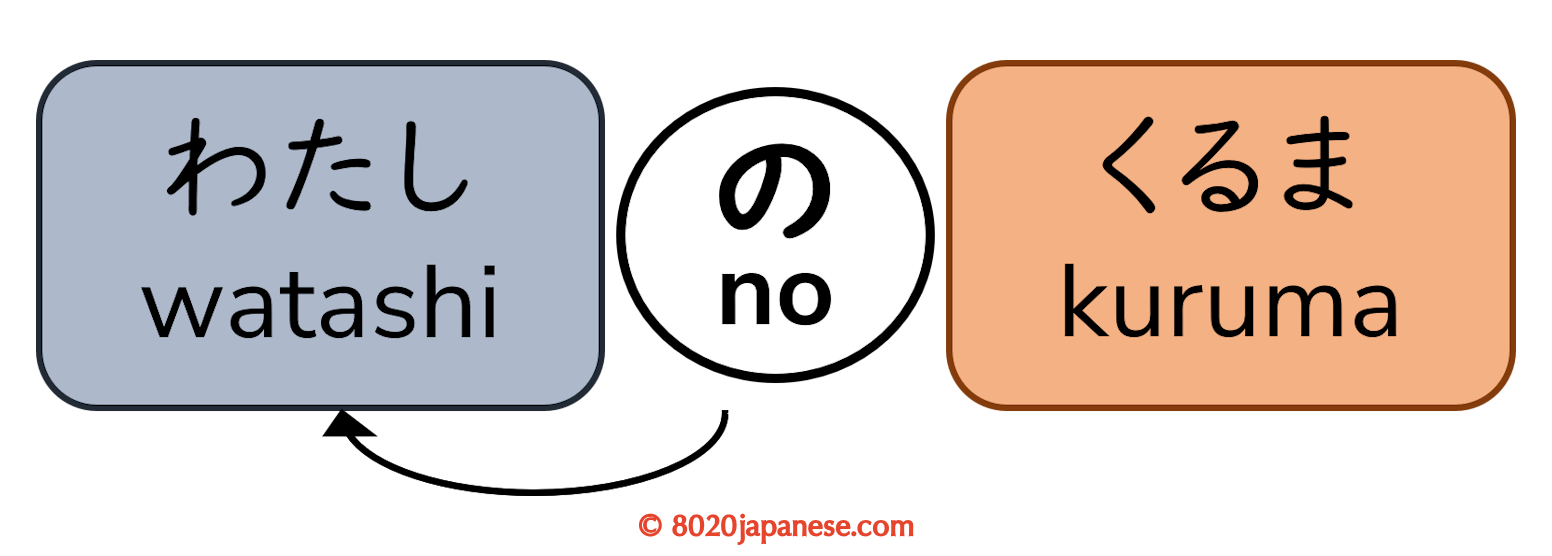
This time, the word “watashi” is marked by the particle “no”. This tells us that “watashi” is the possessor of the thing that follows, which in this case is “kuruma”, meaning “car”. The combination therefore means, “my car”.
With just these two examples, you can already see the pattern: a particle tells you something about the word that comes before it and how that word relates to the rest of the sentence.
English vs Japanese Sentence Structure
To really understand particles, it helps to see how they compare to the way English works. By comparing Japanese to English and understanding the key differences (and also the similarities), it should become apparent just how logical particles are.
In both languages, what matters is how the roles of the elements in a sentence are defined.
How English defines roles: Word order
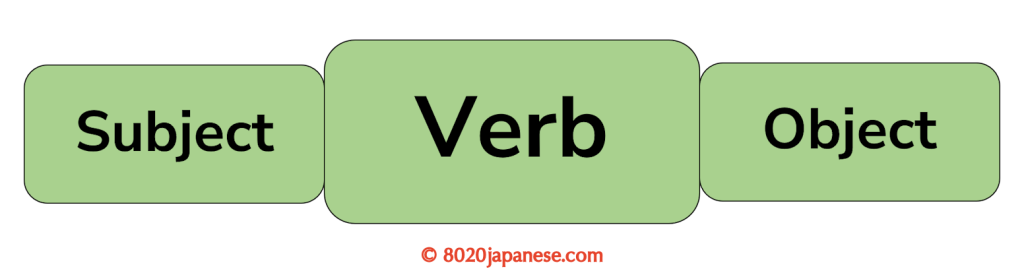
Let’s take a simple English sentence:
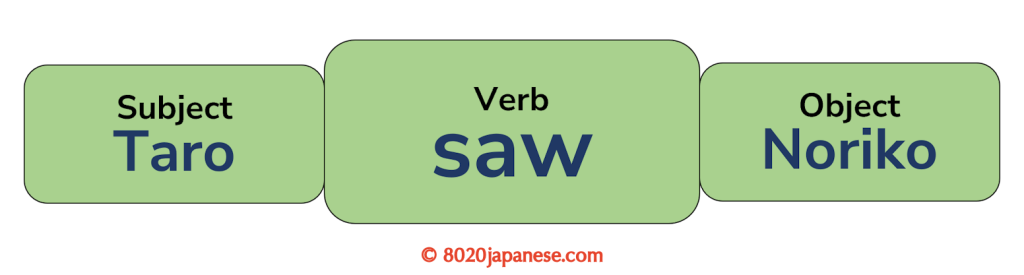
Taro saw Noriko.
There are three pieces here:
- a subject (“Taro”)
- a verb (“saw”), and
- an object (“Noriko”).
How do we know that Taro is the one doing the seeing, and that Noriko is the one being seen?
Word order.
In English, the subject comes before the verb, and the object comes after it. If you rearranged this to “Noriko saw Taro,” the meaning would completely change.
In English, for this core part of the sentence, it is the word order that tells us who is doing what to whom.
How English adds extra information: Prepositions
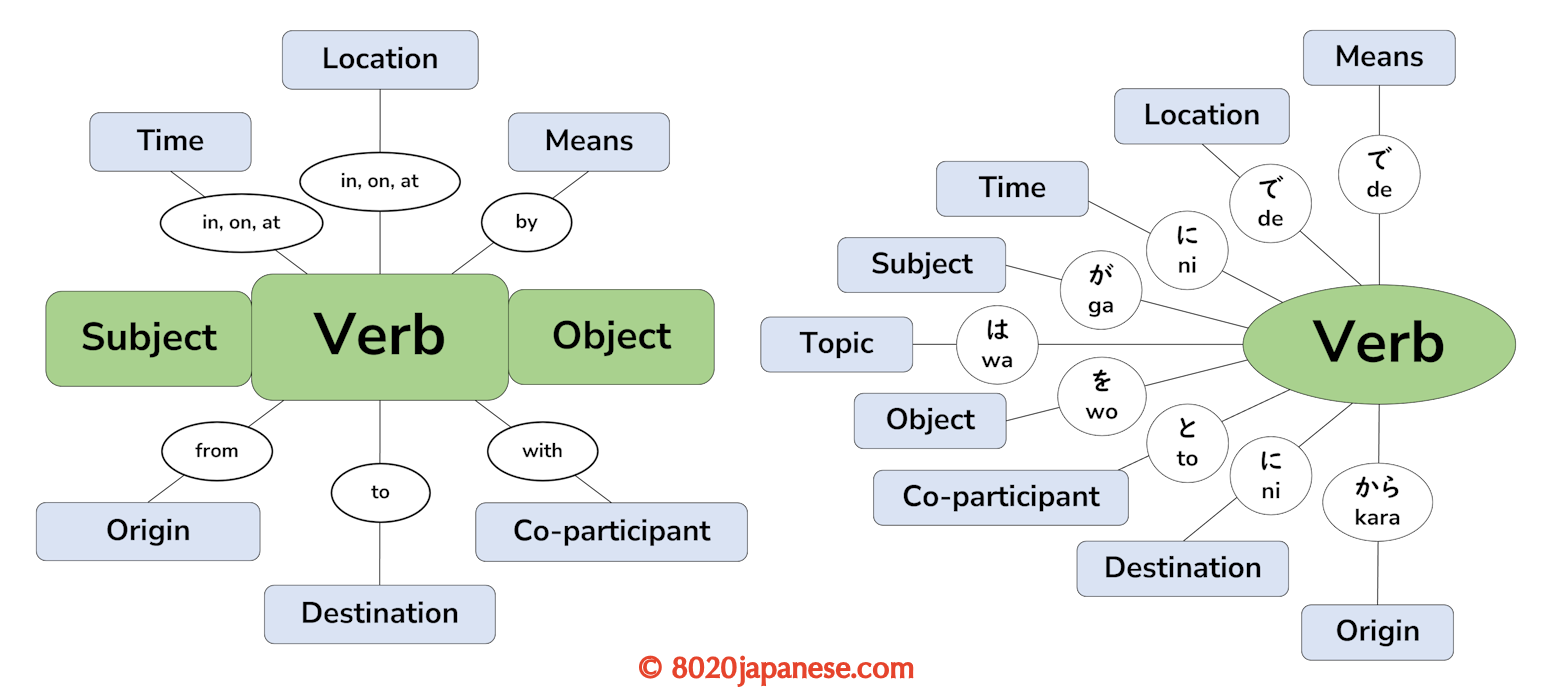
When we want to add extra information, in most cases we use prepositions – words like “at,” “on,” “to,” “from,” “with,” and “by”. These prepositions describe how that extra information is related to the core action:
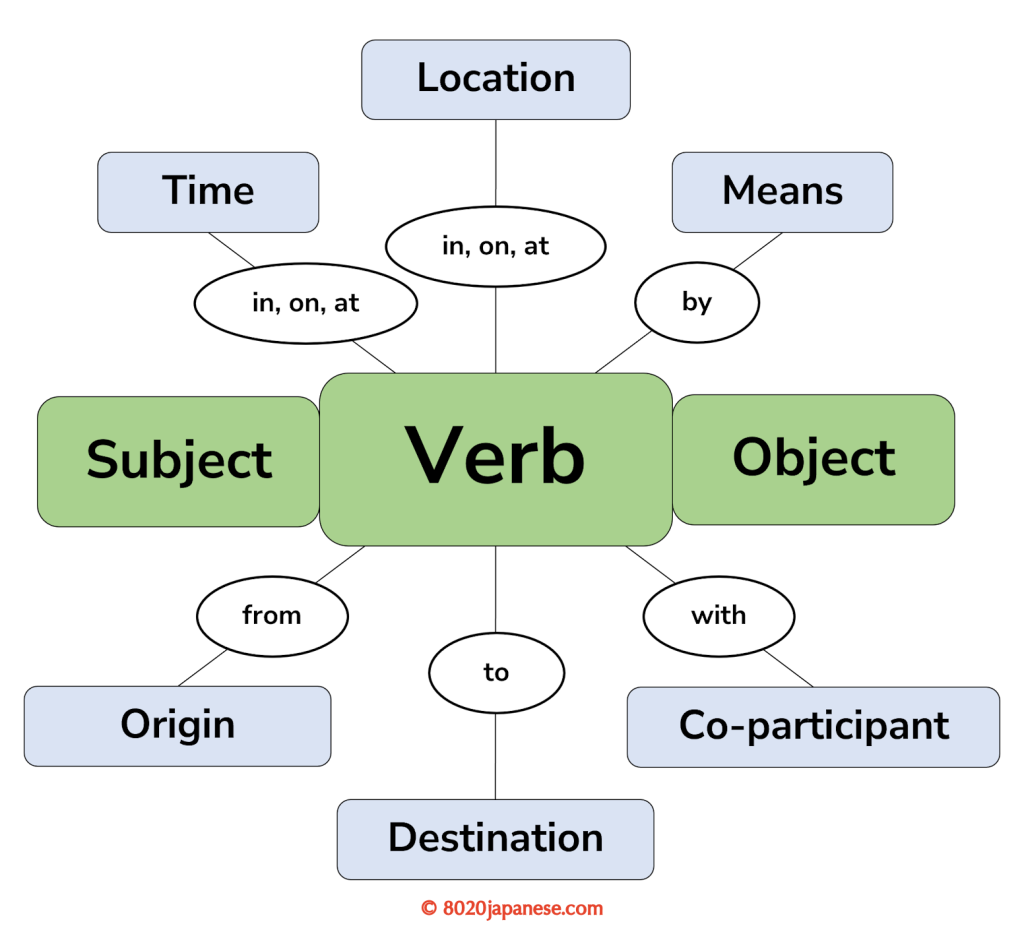
For example, we could add more detail to the above example sentence like so:
Taro saw Noriko at the library on Sunday.
The core action being described is still “Taro saw Noriko”, but we’ve added the location and the time when the action occurred. We did that by using the prepositions “at” and “on”, respectively. Using the diagram above, that looks like this:
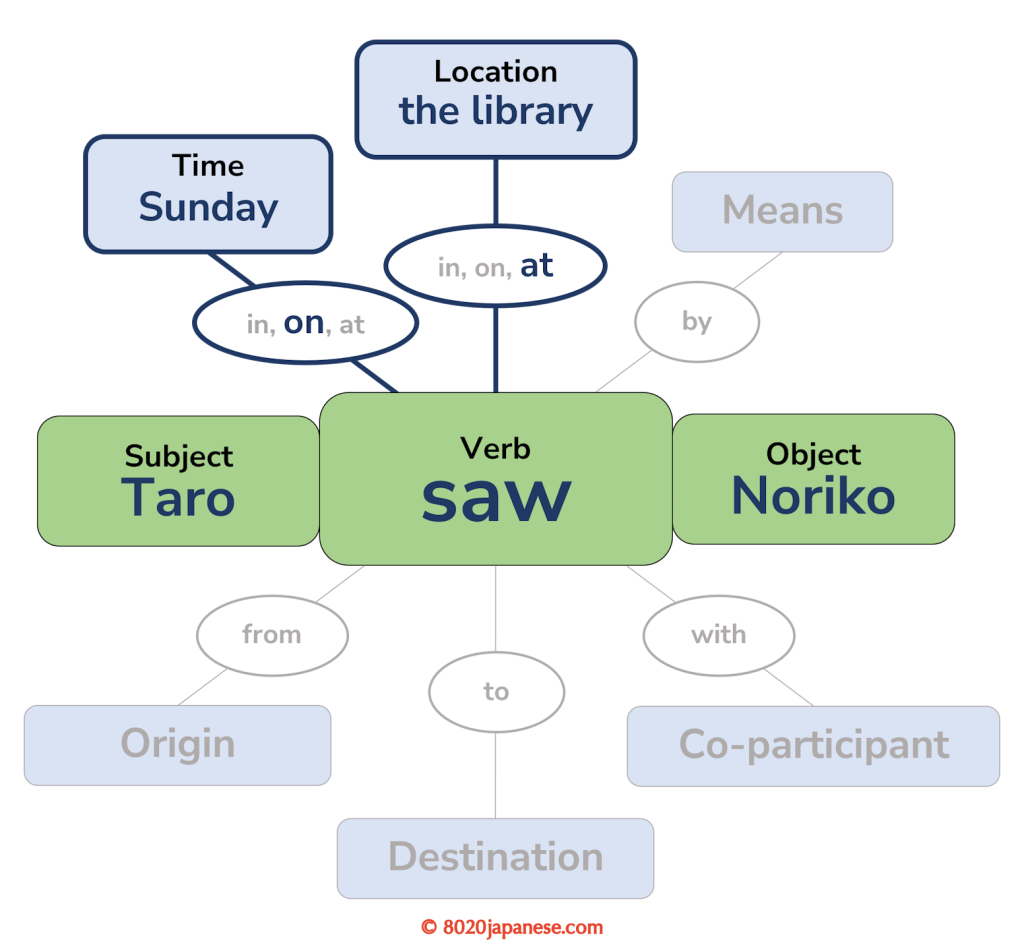
So English uses two systems: word order for the subject and object, and prepositions for almost everything else.
How Japanese defines roles: Particles
Japanese does things a little bit differently. Instead of relying on word order to mark the subject and object, Japanese uses particles for (almost) everything.
All of the major roles in a sentence – the topic, subject, object, location, time, destination, means, and more – are defined by a particle. They each relate directly to the verb, with the particle telling us what that relationship is.
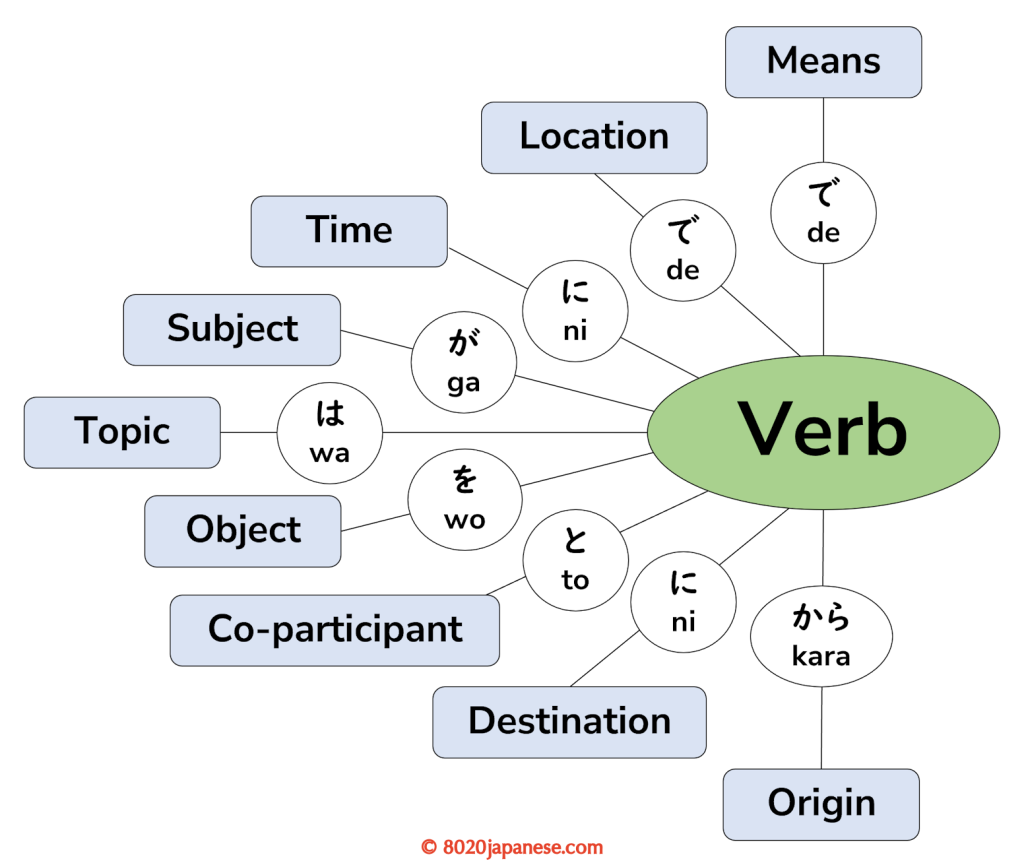
Here’s our first, simpler example sentence from earlier in Japanese:
In our diagram, it looks like this:
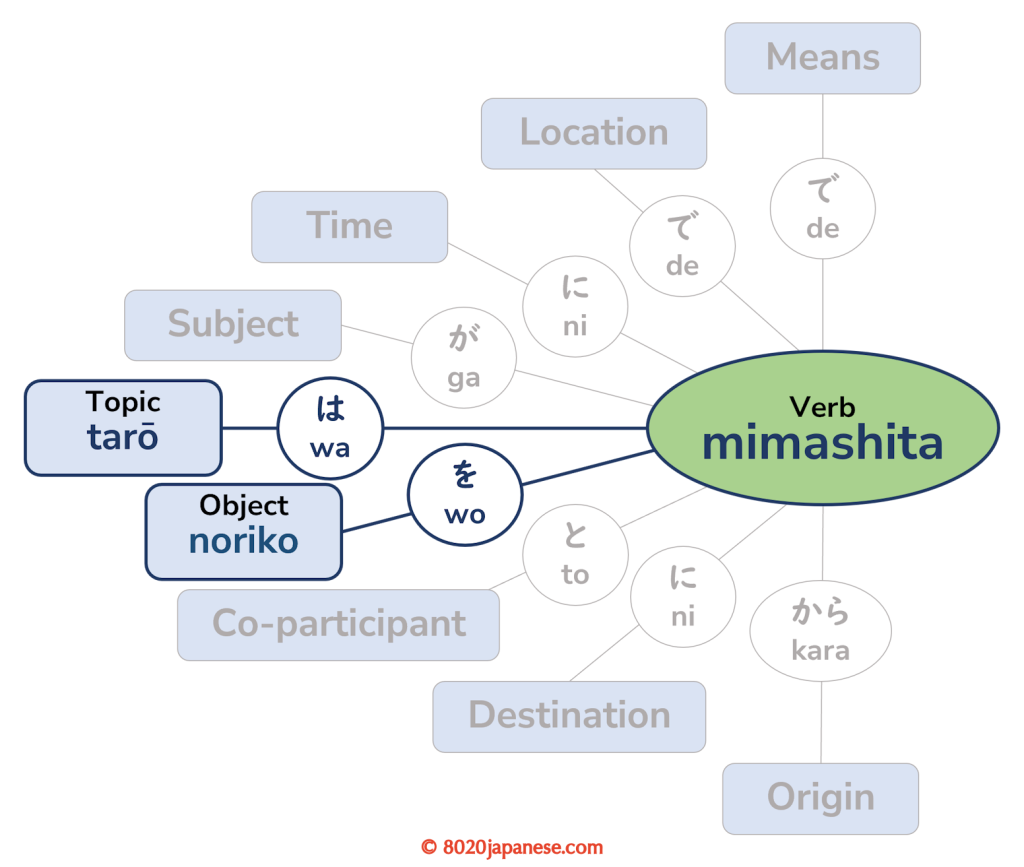
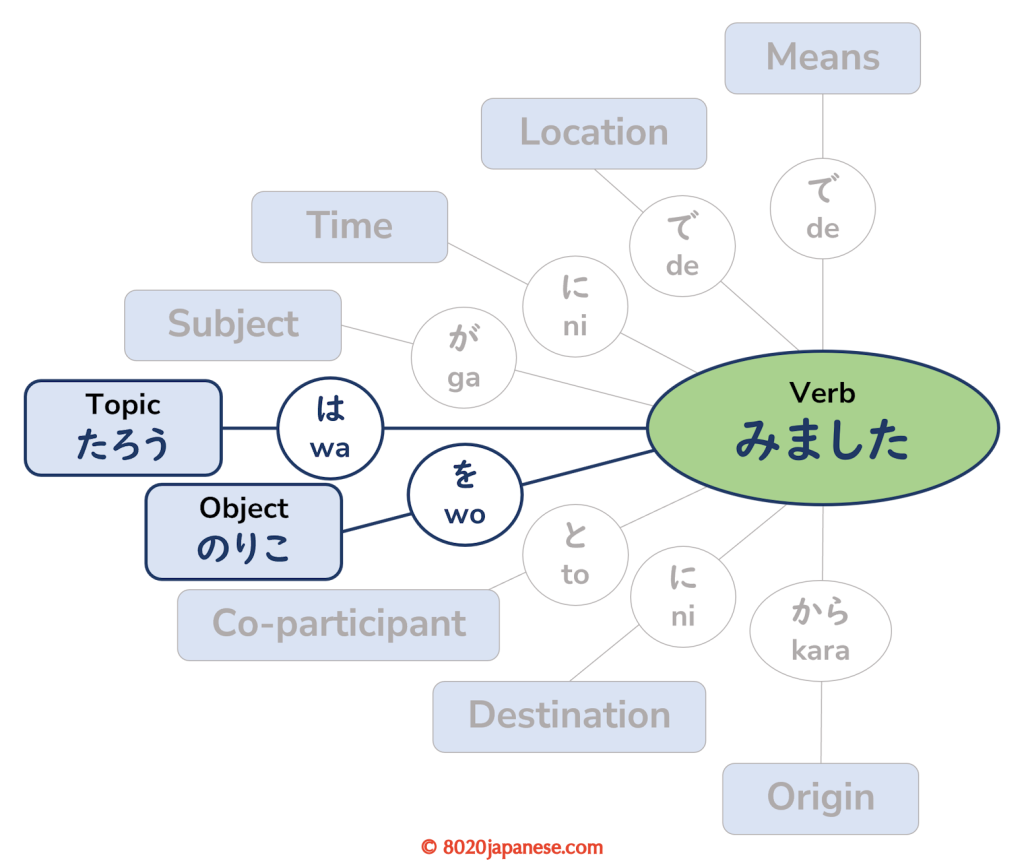
As you can see, in this sentence we have two particles:
- “wa” tells us that “Tarō” is the topic – the person/thing we’re talking about for this sentence
- “wo” tells us that “Noriko” is the object – the person who the action was done to
Both of these relate to the verb, “mimashita”, which is the past tense of “see”. This goes last because in Japanese, verbs always go at the end of the sentence.
So, the sentence is about Taro, the person who was seen is Noriko, and the action is “saw”: “Taro saw Noriko”.
Importantly, the reason we know this is not because of the order of the words in the sentence, but because of the particles. Remember:
Particles tell us the role of each word (or phrase) in a sentence.
English uses prepositions to define some roles, but the subject and object especially are identified by their placement in the sentence. In Japanese, every major role is defined by particles, including the subject and object.
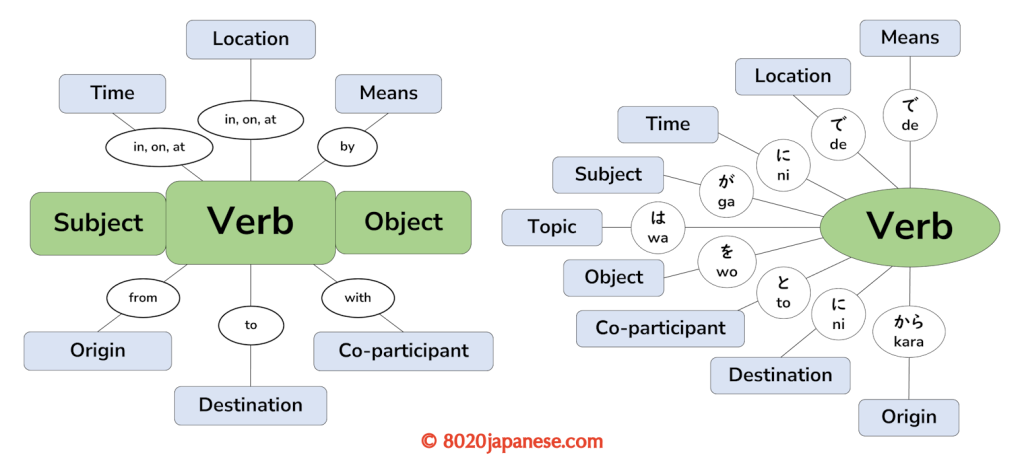
This is a fundamental difference with English, and it’s the key to understanding Japanese particles and sentence structure.
Adding Extra Information in Japanese Sentences
To add extra details, like the location and time, we just include this information with the appropriate particles, like so:
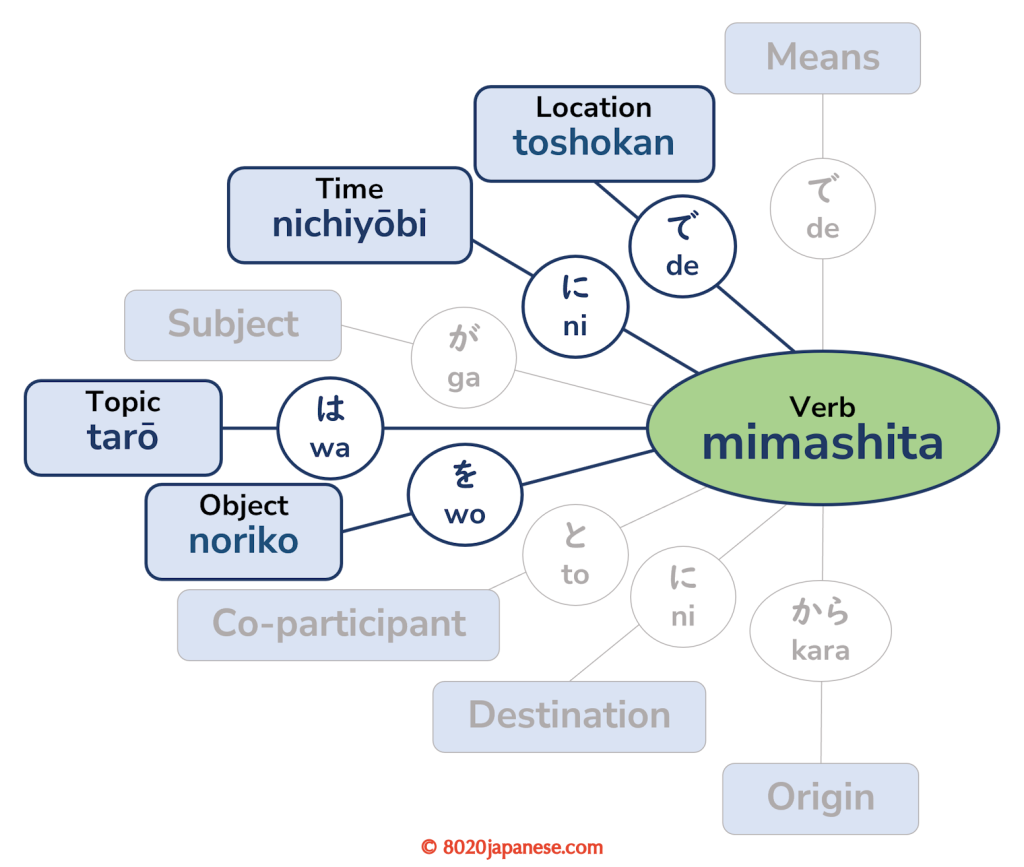
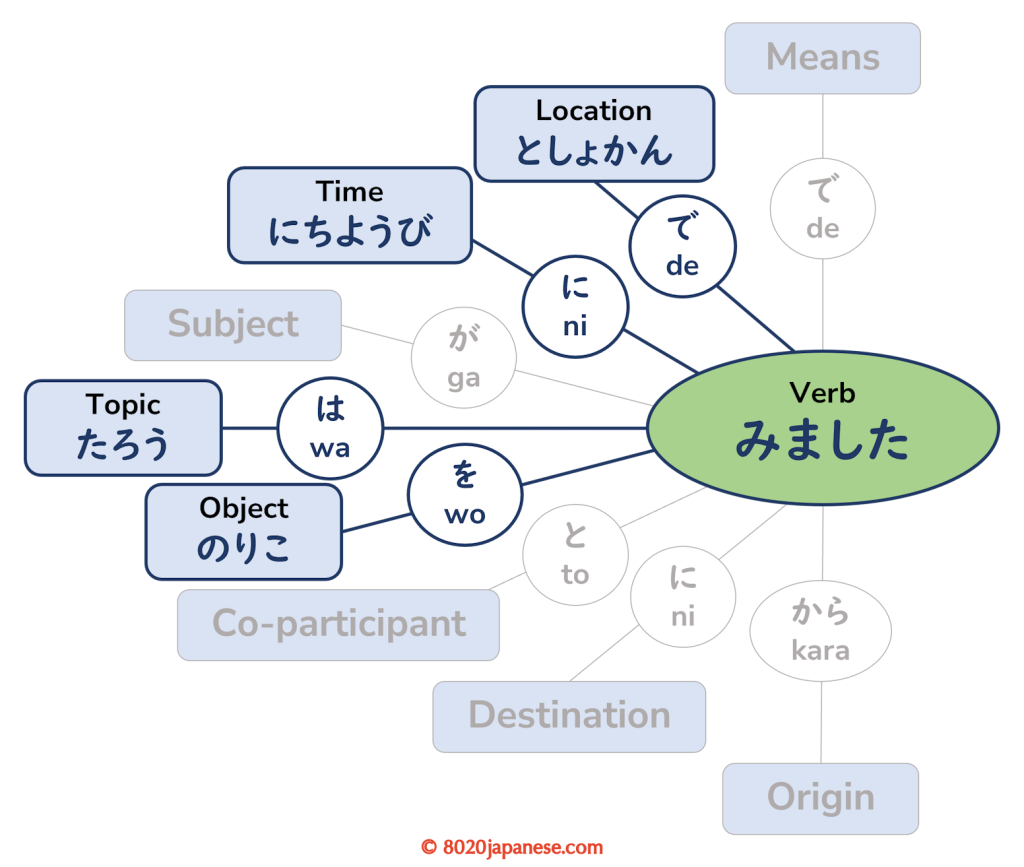
We can write this as a sentence like this:
All we have done is add two extra pieces of information – time and location – together with the particles that define those specific roles:
- “ni” tells us the time when the action took place, which is “nichiyōbi”, meaning “Sunday”
- “de” tells us the location where that action took place, which is “toshokan”, meaning “library”
In total, we now have four roles defined by different particles:
- topic
- object
- time
- location
We can include as many or as few elements as we want. The key is to ensure we use the right particles with the right elements to make it clear what role those elements play in the action being described.
The Particle System: How To Build Sentences
We now know that particles tell us what role a word or phrase plays in a sentence, and that we choose the right particle for a given element based on how that element relates to the verb.
For this knowledge to be useful, however, we need to know how to put everything together to form a sentence.
The visual sentence model
We can visualize the basic structure of a Japanese sentence like this:
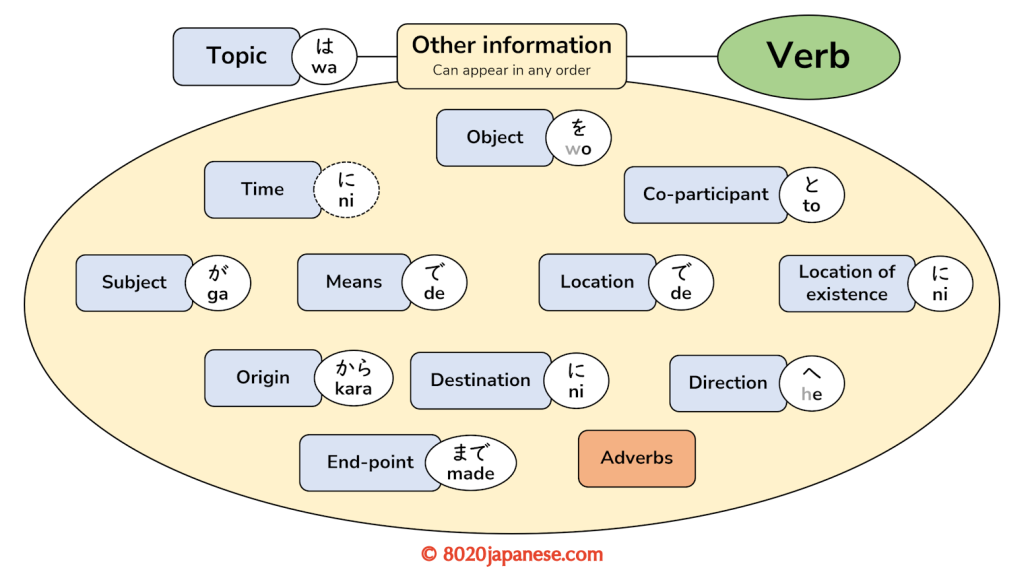
There are three main parts:
- The topic, marked by “wa”, which typically sits near the beginning
- The verb, which always goes at the end
- The “Other information” section, which goes in between these two
The “other information” section includes all of the other major roles, such as the object, subject, destination, location, time, means, co-participant, and more. Each of these typically takes the form of a noun, and are marked by the appropriate particle that defines that role.
Importantly, since it is the particles that tell us the role of each word, elements in the “other information” section can generally appear in any order. As long as the correct particles are used to mark each element, their roles will be clear and the sentence will make sense.
Here’s how we would apply this model to our example from earlier:
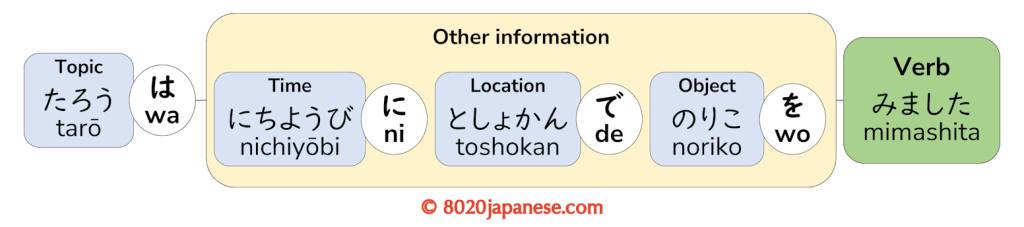
We first have our topic, “tarō” marked by the particle “wa”.
Then, in the “other information” section, we have three elements – the time, the location and the object.
Thanks to their roles being clearly defined by their particles, these can appear in any order. For example, we might instead express this sentence like so:
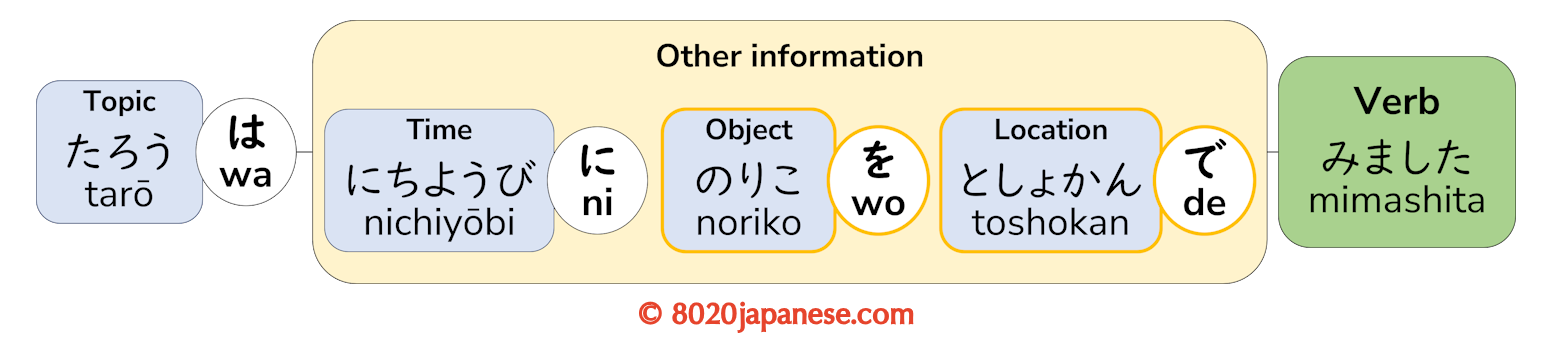
Even though the object and location have swapped positions, the literal meaning of this sentence is exactly the same as the first one because we have kept the particles together with the words whose role they define. The time is still Sunday, the location is still the library, and the person that Taro saw is still Noriko; the particles make this clear.
That said, the different word orderings each have a slightly different nuance. In Japanese, words that appear later in a sentence typically carry more weight, so this second version of the sentence puts more emphasis on the location. The action being described, however, is exactly the same.
Essential Japanese Particles Explained
Now let’s go through each of the most important particles. For each one, I’ll explain what it does, show you how it works in sentences, and point you to a more detailed guide if you want to go deeper.
wa — The Topic Particle
Despite being written with the hiragana “ha”, this is pronounced “wa” when used as a particle. It marks the topic of the sentence – the thing the sentence is about. For example:
Here, “wa” tells us that this sentence is about “Tarō”. Everything that follows is a comment about him.
The topic particle is one of the first particles most learners encounter, and it’s also one of the most misunderstood, largely because there is no equivalent in English. English relies on context and word order to convey what a sentence is “about,” but Japanese often makes it explicit with “wa”.
One important thing to understand is that the topic is not always the same as the grammatical subject, which is marked by the particle “ga”, described below. Often, a sentence is about the person doing the action, so that person could be either the topic or the subject, but that’s not always the case.
This is where much of the confusion with “wa” and “ga” arises, and it’s something we’ll address in the comparison section below. For a full exploration, see my dedicated guide: The difference between the particles “wa” and “ga”.
ga — The Subject Particle
The particle “ga” marks the grammatical subject of the sentence – the person or thing performing the action. For example:
Here, “ga” identifies “ame” (“rain”) as the thing that is doing the falling.
As mentioned above, the topic of a sentence and the subject of a verb are often the same, making it hard to know whether to use “wa” or “ga”. In simple terms, “ga” is often used when introducing new information, answering a question about who or what, or when the person doing the action is the focus of a question or statement. For example:
📖 Deep dive: The Japanese Particle が — What it’s for and when to use it
wo/o — The Object Particle
The particle “wo” (written “wo” in romaji but pronounced “o”) marks the direct object of the verb – the person or thing that the action is done to. For example:
As discussed earlier, we know Noriko is the object here because “wo” comes immediately after her name, telling us that she is the person the action was done to. In English, this role is defined by word order (the object usually comes immediately after the verb), but in Japanese, the particle “wo” defines the object, regardless of where in the sentence the word appears.
📖 Deep dive: The Japanese Particle “wo” (o): What it is and when to use it
ni — Destination, Time and Location of Existence
The particle “ni” is one of the most versatile particles in Japanese. It is used to define the destination of actions that involve movement, as well as points in both time and space.
Destination
The particle “ni” marks the destination of an action involving movement. For example:
Here, “ni” marks “gakkō” , meaning “school”, which tells us that this was the destination of Taro’s “going”.
The destination can also be a person or place where something moves towards as a result of actions like “giving” or “sending”. For example:
Here, the verb is “agemashita”, meaning “gave”, and the object of that verb – the thing that was given – is “hon”, meaning “book”, as marked by the particle “wo”. With just this information, we know a book was given.
The destination, as marked by the particle “ni” is “Noriko”, so Noriko is where the book moved towards as part of the act of “giving”.
Time (specific points)
With time phrases, “ni” marks the point in time when the action takes place. For example:
Note, however, that it’s used with specific times and days, but not with relative time words like “today” or “tomorrow”. Read more about this in my article: Japanese Expressions of Time (and when to use the particle “ni”)
Location of existence
In Japanese, there are two distinct ways to describe a location – where an action takes place, and where someone or something exists.
The particle “ni” is used when describing where something exists, particularly when using the verbs “arimasu” and “imasu”. For example:
📖 Deep dive: How to use the particle NI for destinations, locations and time
de — The Location and Means Particle
The particle “de” has two primary uses. It can be used to define:
- The location where an action takes place
- The means by which an action is done.
Location
The location where an action takes place is defined using the particle “de”.
Here, “de” tells us the location where the act of studying happened.
As noted above, this is distinct from the location where something exists, which is defined using the particle “ni”. Learn more about this distinction in my dedicated article about location particles: Ni vs De: How to choose between these two location-defining particles
Means
The “means” can most simply be described as something that is used to complete the action. This can take a variety of forms, such as a mode of transport, a tool or instrument, or a method.
Here’s an example where the means is a mode of transport:
In this example, “de” marks “basu”, meaning “bus”, which tells us that this is the mode of transport – something that was used to complete the action.
Here’s an example where the means is a tool:
Once again, “de” marks something that was used to complete the action, which this time is the tool or device – “kētai” (mobile phone) – that Noriko used to take the photo.
📖 Deep dive: The Japanese particle で (de): When and how to use it correctly
to — “With”, “And” and Quotations
The particle “to” has three main uses, two of which are closely related.
Co-participant (“with”)
The particle “to” can be used to define a co-participant – someone who is involved in the action together with the person who is the subject or topic.
The main action here is, “I went to a cafe”, and by including “tomodachi to”, we’re saying that a friend completed the same action together with me.
Complete list (“and”)
The particle “to” can also be used to connect nouns into a complete list, much like certain uses of the word “and” in English. However, this works quite differently to the other particles we’ve looked at so far. Here’s an example:
The meaning here is very similar to the co-participant application of “to”, but with an important difference.
This version of “to” does not connect directly to the verb, but instead it joins multiple nouns together into a larger noun phrase. This larger noun phrase will then usually be marked by another particle.
In the example above, “kōhī to kōcha”, as a whole, is the object marked by the particle “wo”. They are, together, the thing that was ordered. Visually, it looks like this:
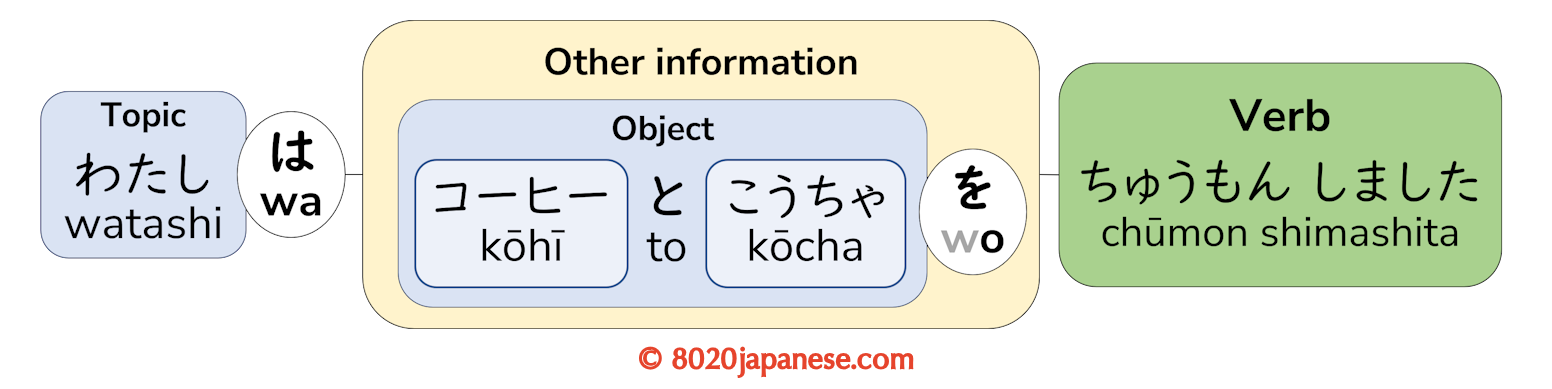
However, when “to” marks a co-participant, it defines a direct relationship between that person and the verb. It states that that person did the action together with the main protagonist of that sentence.
Here’s an example that uses both together:
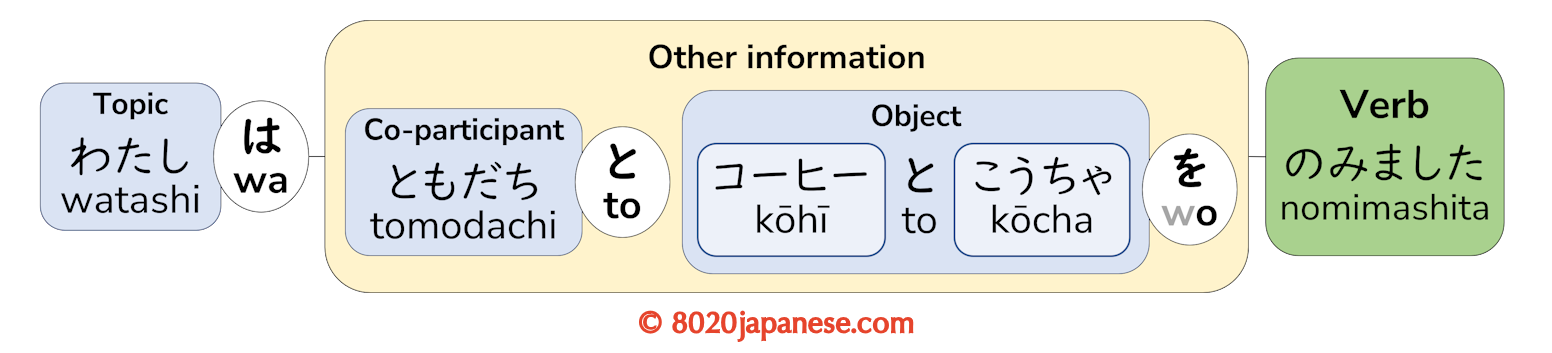
Here, the person I drank with is “a friend”, and the thing we drank is “coffee and tea”.
You can see here that the distinction between the two different roles matters. If we put “tomodachi to” inside the object bubble, it would mean “I drank a friend, coffee and tea.” Nobody would interpret this sentence that way, but you can see how this could lead to misunderstandings in certain situations. Recognizing the two distinct roles defined by “to” should help minimize this risk.
Quotations
Unrelated to the two uses described above, “to” is also used to mark quotations – what someone said or thought. The quote can be as simple as a single word, or it can also be a much more complex phrase or sentence.
Here’s an example of something that was said:
And here’s an example of something that is thought:
kara and made — “From” and “To/Until”
These two particles often appear together to mark starting and ending points in time or space.
Example in time:
Example in space:
In space, the particle “made” is sometimes interchangeable with “ni” when it is used to describe a destination, but this doesn’t always work as they each have different nuances. The distinction is explained in detail in the article linked below.
📖 Deep dive: The particles 「から」(kara) and 「まで」(made): Saying “from” and “until” in Japanese
Other types of particles
For all of the above particles (except for the “and” version of “to”), the particle describes the relationship between a word or phrase and the verb.
However, there are other types of particles that work in different ways. Even so, they still tell us about the word or phrase the comes before them.
Let’s look at some of the most common particles that work differently to the main ones described above.
no — The Connecting Particle
The particle “no” connects two nouns, showing that one belongs to, describes, or is associated with the other. It most commonly shows possession.
Importantly, this is a different type of particle to most of the others described here. Instead of describing a relationship between something and the verb of the sentence, it more simply connects two nouns (or noun phrases) to describe a direct relationship between those two things.
Possession
When used to describe possession, the particle “no” tells us that the thing before it is the possessor of the thing that comes after it. Put another way, the thing that comes after “no” belongs to the thing before.

For example:
Here, “watashi”, meaning “I” or “me”, is before “no”. This defines “me” as the possessor of the thing that comes after “no”, which in this case is “kuruma”, meaning “car”.
I am the possessor of the car (= the car belongs to me), so this more simply means, “my car”.
This, however, is not a sentence, but a noun phrase. To build a sentence that includes this, we would mark the whole phrase with an appropriate particle. For example:
Here, “watashi no kuruma”, meaning “my car”, is marked by the particle “wo”, telling us that this is the thing that was borrowed.
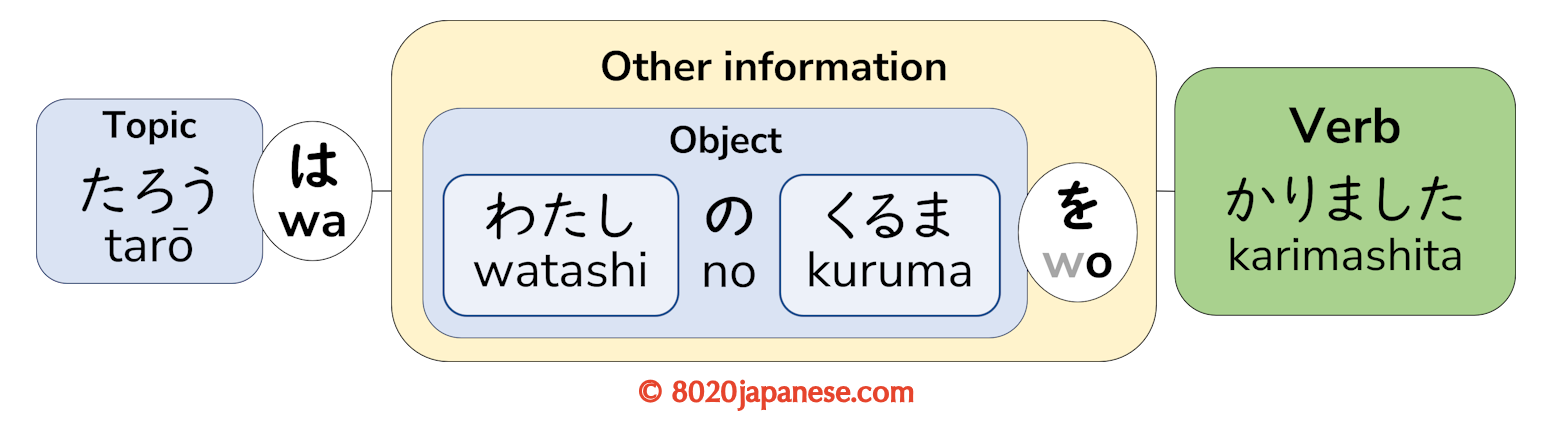
Notice that the particle “wo” applies to the whole phrase “watashi no kuruma”, not just the word “kuruma”.
Particles tells us the role of the word or phrase that comes before them, and in this case, instead of “wo” marking just a single word, it marks a slightly more complex noun phrase: “watashi no kuruma”.
Association/description
The particle “no” can also be used to connect two nouns in a descriptive way, where the word before “no” describes something about the word that comes after it.
For example:
Here, “no” connects “nihongo” (“Japanese language”) to “sensei” (“teacher”), telling us what kind of teacher it is.
Importantly, the phrase as a whole refers to the person or thing that comes after “no”, not the other way around. In a noun phrase like this, the last noun is the thing being described, and the words connected to it using “no” simply provide more information about that thing.
For example, if we swapped the order to say “sensei no nihongo”, that would effectively refer to the teacher’s Japanese language ability – “the teacher’s Japanese”.
Here is an example of a sentence that includes “nihongo no sensei”:
In this sentence, the whole phrase “nihongo no sensei” is marked by the particle “ni” because “the Japanese teacher” is the destination of the email that was sent.
We can also stack multiple instances of “no” to form even longer descriptive phrases. For example:
This, too, can be used in a sentence in the same way as we did with “nihongo no sensei”:
mo — The “Also” Particle
The particle “mo” means “also” or “too”. The meaning of “also” applies specifically to the word or phrase that it marks.
In practice, “mo” effectively replaces “wa”, “ga” or “wo”. For example:
Notice that “mo” is used in place of “wa” in the second sentence. This adds the meaning of “also” to tell us the “Noriko also” is a student.
Here’s an example where “mo” replaces “wo”:
This time, “mo” has replaced “wo” because the magazine is the thing that the action was also done to.
When using “mo”, it should always be associated with the element in the sentence that the “also” applies to. If that is the topic, subject or object, then “mo” should be used instead of “wa”, “ga” and “wo”, respectively.
However, it’s not limited to applying the meaning of “also” to these roles. We can also use “mo” with other particles like “ni” and “de”. The difference is that with these other particles, the original particle is kept and “mo” is placed immediately after it.
Here’s an example where the “also” element is the destination:
And here’s an example where the “also” element is the location where the action takes place:
ka — The Question Particle
In Japanese, turning statements into questions is as simple as adding the particle “ka” to the end of the sentence.
For example, if we take a statement like this:
We can turn it into a simple yes/no question by simply adding “ka”, like this:
Notice again that in English, the word order determines if it is a statement or question, but in Japanese, it is the particle.
It can, of course, also be combined with question words (like those that mean “what”, “when”, “why”, etc.) to ask open questions. For example:
yo and ne — Sentence-Ending Particles
Similar in usage to “ka”, the particles “yo” and “ne” are sentence-ending particles that alter the tone of the sentence. Specifically, they add emotion or nuance to how a statement is delivered.
“yo” adds emphasis or conveys new information to the listener, similar to saying “you know” or “I’m telling you”:
“ne” seeks agreement or confirmation, like adding “isn’t it?” or “right?” in English:
These particles don’t change the grammatical structure or meaning of a sentence, but they do change the tone and play an important role in natural conversation.
📖 Deep dive: Using 「よ」(yo) and 「ね」(ne) to speak more natural-sounding Japanese
Common Particle Confusions (and How to Resolve Them)
Two particle pairs cause more confusion than any others. Let’s address them head-on.
wa vs. ga — Topic vs. Subject
This is the single most common source of confusion for Japanese learners, and for good reason. English doesn’t have a grammatical topic, so there is no need to distinguish between “topic” and “subject” in the same way.
The basic definition of these two is this:
- The topic is who or what the sentence is about
- The subject is the person or thing that performs the action.
The reason these are so confusing is because “the person who the sentence is about” and “the person who did the action” are often the same person! That means that person could be expressed as either, so we have to choose one. The difference is in where the focus of the sentence lies.
Here’s a simplified way to think about it:
“wa” (topic) sets the stage. It provides context so we know what the rest of the sentence is about. Think of it as saying, “As for X…” or “Speaking of X…”
“ga” (subject) identifies the person or thing performing the action. It points to the specific person or thing that is doing something (or “being” something), and is most often used when the “who” is the new or important information.
Consider these two sentences:
Both sentences tell us that the person referred to as “he” is a spy, but the nuance is very different.
When “wa” is used, this tells us that the sentence is about “kare”, and is simply describing something about him. It would be an appropriate response to a request like, “tell me something about him”.
However, when “ga” is used, it emphasizes that “kare” is performing the act of “being a spy”. The implication is that it is known that there is a spy, and this sentence is making it clear who that spy is. It would be an appropriate answer to the question, “who is the spy?”
In simple terms, “wa” provides the context need to know what the rest of the sentence is about, while “ga” defines a key role in the action being described – the person or thing who does the action.
📖 Full guide: The difference between the particles は (wa) and が (ga)
ni vs. de — Two Kinds of “Location”
Both “ni” and “de” can relate to location, but they do so in different ways.
“de” marks where an action takes place:
“ni” marks where something is or exists, particularly when used with the verbs “imasu” and “arimasu”:
The key distinction is that “ni” is about being, while “de” is about doing. If the verb involves an active action happening at a location, use “de”. If it’s about where someone or something is simply being or existing, use “ni”.
As described earlier, “ni” is also used to define the destination of an action involving movement, though that is typically less confusing.
📖 Full guide: Ni vs De: How to choose between these two location-defining particles
How to Actually Learn Particles (Not Just Memorise Them)
The easiest mistake to make when trying to learn Japanese particles is to try to “translate” them to English. Some particles match up neatly with English prepositions, but most do not, and trying to think of particles in English terms is a recipe for confusion.
What works much better is understanding the specific role that each particle defines. Once you see that each of the main particles connects a word back to the verb, and you understand what kind of connection each particle defines, you can start building sentences from scratch — not just repeating phrases you’ve memorised.
Here are some principles that help:
Understand, don’t just memorise. When you encounter a new particle, don’t just learn ““ni” = to/at/in.” In many situations it’s none of these. Instead, learn why “ni” is used in each context and what roles it is used to define, such as “destination”, “time” or “location of existence”. Differentiate these from roles like “location where an action takes place” or “starting time”.
Build sentences, don’t just read them. Try constructing your own sentences with each particle. Start with simple sentences that just have a topic, an object and a verb, then gradually add more elements. The act of building sentences yourself is what turns passive knowledge into active ability. My article about Japanese word order offers practical tips for building simple sentences with multiple elements.
Compare confusing pairs directly. When two particles seem similar (like “ni” and “de” for location), put example sentences side by side and identify exactly what’s different. The distinction usually becomes clear once you see them in contrast.
Think in terms of descriptive roles, not abstract definitions. Instead of thinking ““wo” = the object marker,” think ““wo” tells me what the action is being done to.” This role-based thinking maps more naturally to how we view and think about the world, rather than getting stuck thinking about things in abstract terms.
💡 This is exactly the approach we take in 80/20 Japanese: Foundations. The course is designed around understanding why Japanese works the way it does, with visual diagrams, step-by-step explanations, and exercises that help you build genuine sentence-making ability. If you’ve been frustrated by courses that just hand you phrases to memorise without explaining the underlying logic, this course was built for you.
FAQ: Common Questions About Japanese Particles
How many particles are there in Japanese?
There are around 188 particles documented in Japanese, but don’t let that number intimidate you. In everyday conversation and reading, a core set of about 10-15 particles covers the vast majority of what you’ll encounter (a great example of the 80/20 principle). Master the ones in this guide, and you’ll have a strong foundation for the large majority of Japanese sentences.
Do I need to memorise all the particles before I can start speaking?
Not at all. You can start building useful sentences with just “wa”, “wo”, and “ni”. Add “ga” and “de”, and you can express a wide range of ideas. Learn particles gradually through use, not by trying to memorise a complete list.
What happens if I use the wrong particle?
In most cases, Japanese speakers will still understand you from context. Particle mistakes rarely cause total communication breakdown. That said, using the wrong particle can change the meaning of a sentence (did you “eat a restaurant”, or did you “eat at a restaurant”?), so it’s worth developing accuracy over time.
Why is は pronounced “wa” and not “ha”?
This is a historical quirk. In classical Japanese, the character “ha” was pronounced “wa” in many contexts. Modern Japanese has kept this pronunciation specifically for the particle “wa”, even though the character is pronounced “ha” in all other uses. The same applies to the particle “e”, which is pronounced “e” rather than “he.”
Can I just drop particles in casual speech?
Yes, in casual spoken Japanese, particles are often omitted, especially “wa” and “wo”. However, this only works because both speaker and listener share enough context to fill in the gaps. As a learner, it’s much better to master using particles correctly first. Once you have a solid grasp of what each particle does, you’ll naturally develop a feel for when they can be left out.
What’s the difference between に and へ for destination?
Both can mark a destination, but “e” emphasises the direction of movement (“towards”), while “ni” emphasises the arrival point (“to”). In practice, they’re often interchangeable for destination, but there are situations where one is more appropriate than the other. Of course, “ni” also has other uses (time, location of existence) that “e” does not.
Is there a particle for “from”?
Yes, the particle “kara” marks the origin, or starting point, in both time and space, such as when saying “from Tokyo” or “from tomorrow.” See the full guide to から and まで for details.
Start Building Real Japanese Sentences
Truly understanding how particles work is the key to moving beyond memorised phrases and actually expressing your own thoughts in Japanese. They’re the glue that holds all the pieces of a sentence together and gives it a clear meaning.
They can take some getting used to, but particles are incredibly logical, and once you understand the system, every new particle you learn slots neatly into that framework.
In this guide, you’ve seen how particles compare to English word order and prepositions, how they all connect back to the verb, and how each of the most common particles works in practice.
But reading about particles is only the first step. Knowing something doesn’t automatically translate into being able to apply it. To actually learn to speak and understand Japanese takes practice – building your own sentences, making mistakes, and developing an intuitive feel for which particle fits where.
That’s exactly what 80/20 Japanese: Foundations is designed to help you do. The course covers all of the major particles in depth, with clear visual explanations, progressive exercises, and a focus on understanding the why behind every grammar point. It’s built for learners who want to move beyond memorising set phrases and start genuinely expressing themselves in Japanese.
Learn more about 80/20 Japanese: Foundations →
Want to go deeper on a specific particle? Here are my detailed guides:
- Japanese Sentence Structure: The Ultimate Beginner’s Guide — the visual model for how particles build sentences
- The Object Particle を
- The Particle に
- The Subject Particle が
- The Particle で
- は vs. が: Understanding the Difference
- に vs. で: How to Choose the Right Particle
- The Particles から and まで
- Sentence-Ending Particles よ and ね